
Submersible screw pumps are progressive cavity pumps (hereinafter referred to as PCP / Progressive Cavity Pumps) designed for lifting reservoir fluids from oil wells.
PCP pumps are specifically designed for heavy oil applications. Their design provides:
- Reduced negative impact of sand.
- Improved pump filling efficiency.
- Reduced overall length.
- Application of a special elastomer with enhanced abrasion resistance.
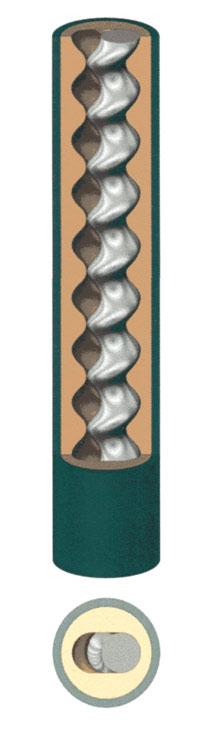
The main components of PCP pumps are the rotating part — the rotor, and the stationary part — the stator.
Rotor
The rotor is a helical screw with a large pitch and a circular cross-section.
Stator
The stator consists of a steel tube with an internal elastomer.
Elastomer
The elastomer is manufactured with a double-helix profile, creating cavities for fluid flow between the rotor and stator.
The rotor and stator are not coaxial; their axes are parallel. The distance between the axes is referred to as the pump eccentricity. As a result, rotor motion is complex: while the rotor rotates in one direction around its own axis, its axis simultaneously rotates around the stator axis in the opposite direction.
As the rotor rotates inside the stator, fluid moves continuously from the intake to the discharge outlet. This feature ensures a stable flow rate proportional to rotational speed.
The recommended operating speed range is from 50 to 400 rpm. Operation at higher rotational speeds is possible; however, it reduces pump service life.
The pressure capability of PCP pumps depends on the number of cavities in the pump.
To preserve the elastic properties of the pump, it is not recommended to exceed the rated head specified by the pump design. The maximum pressure value is indicated in the pump designation structure.
The optimal balance between operating costs and pump service life is achieved at approximately 80% of the maximum pressure rating. Exceeding this pressure significantly reduces elastomer life and may result in elastomer deformation.
Pump capacity may vary within ±5% of the nominal flow rate from zero head conditions and will change depending on well characteristics.
Gas inside the pump may create operational problems because the pump requires fluid for lubrication. To maintain high fluid head in the well, gas effects can be reduced by setting the pump below the perforation interval and/or by operating at lower rotational speeds.