
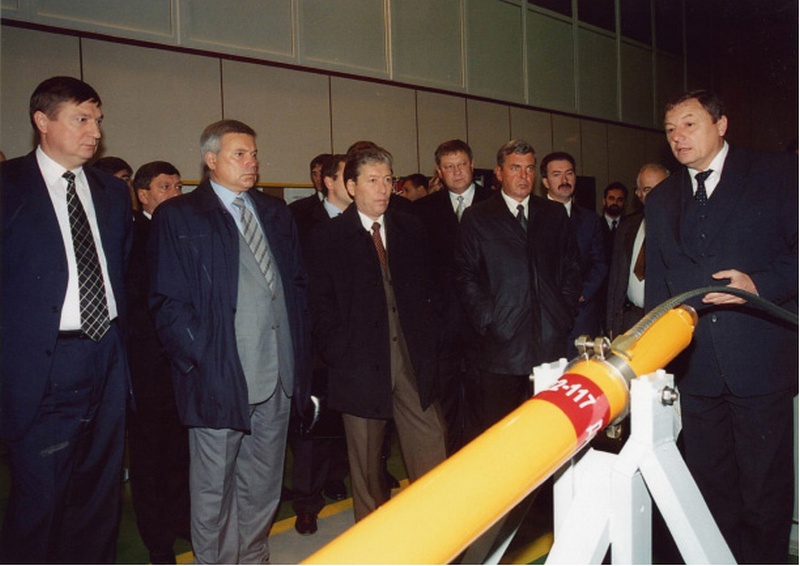
The knowledge and experience of the participants of the corporate project of LUKOIL enabled them to become among the first to develop and patent innovative Russian equipment for artificial oil production — submersible permanent magnet motors.
December 1994
LUKOIL signed a memorandum of intent to cooperate in the development of ESP drives based on permanent magnet motors with AEROELECTRIC, a leading enterprise of the military-industrial complex specializing in electric drives for aerospace applications (formerly Dzerzhinets Machine-Building Plant).1995
Recognizing the importance of improving the operational efficiency of electric submersible pumps and, above all, reducing energy consumption in oil production, LUKOIL gave serious consideration to the proposal from AEROELECTRIC to develop fundamentally new high-efficiency drives for oilfield equipment.Taking into account the strong scientific and engineering potential of the defense industry, LUKOIL decided to involve its own specialists with extensive experience in oilfield equipment operation. In June 1995, the First Vice President of LUKOIL approved the technical specification for the development of a permanent magnet drive for ESP systems.
February 1996
After reviewing information regarding the development of new drive technologies for aerospace equipment, the Presidium of the Scientific and Technical Society of LUKOIL recommended that the relevant departments consider expanding scientific and technical cooperation with AEROELECTRIC.A decision was made to begin financing the development work. Within the framework of this cooperation, fundamentally new energy-efficient submersible motors with permanent magnets in the rotor were developed based on the new concept.
September 1996
LUKOIL received a utility model patent for a “Downhole Pump Installation,” distinguished by the fact that “the motor installed in the well is contactless and equipped with permanent magnets mounted on the rotor.”This document established the global priority of both the Company and Russia in the development of permanent magnet drives for submersible pumps.
October 1996
A working prototype of the world’s first submersible permanent magnet motor for ESP applications was manufactured (this “museum exhibit” has been preserved and remains operational today).At a meeting held in October 1996 in the city of Kogalym regarding improvements in ESP operating efficiency, a report was presented outlining the prospects of using permanent magnet motors in oil production equipment.
1998
Prototype samples of the new drive systems were tested in wells operated by LUKOIL–Western Siberia and RITEK. The tests confirmed both the feasibility and effectiveness of using these drives for submersible pumps.2000
LUKOIL decided to establish an Innovation and Technology Center within RITEK (RITEK-ITC LLC), inviting a group of leading AEROELECTRIC specialists involved in permanent magnet drive development for oil pumping systems to continue the work.The aerospace engineering approach to new product development enabled RITEK-ITC specialists, within a short period of time, to develop and present for acceptance testing prototype permanent magnet ESP drives with high energy efficiency characteristics. This was achieved through extensive use of advanced developments in power electronics, microprocessor technology, control software, and the rapid global development of permanent magnet manufacturing technologies.
March 2001
Acceptance field testing of permanent magnet drives in wells operated by LUKOIL–Western Siberia and RITEK was completed.Based on the results, the Presidium of the Scientific and Technical Council of LUKOIL supported the recommendation of the acceptance commission to launch industrial production of permanent magnet ESP drives.
December 2001
Production of permanent magnet motors began within the framework of the joint activities of RITEK and LUKOIL ESP Service.The high level of standardization between permanent magnet motors and conventional induction submersible motors in terms of design, materials, and manufacturing technology allowed production to be rapidly organized at LUKOIL ESP Service.
March 17, 2002
The first well equipped with an ESP system using a permanent magnet motor manufactured by LUKOIL ESP Service was commissioned.October 12, 2003
The first well equipped with a PCP system using a low-speed permanent magnet drive was commissioned.These dates can be considered the beginning of the industrial application of permanent magnet drives for submersible pumps in the oil industry both in Russia and worldwide.
In 2003, RITEK-ITC organized serial production of permanent magnet motors and their corresponding control stations.
During the initial implementation period of permanent magnet drives (2001–2004), despite technical and economic challenges, the management of LUKOIL continued to support the project.
Several years were required to refine the motors, confirm their advantages over induction motors, and make the decision to increase their deployment volumes, followed by the gradual replacement within the Company of ESP systems with induction motors by ESP systems using permanent magnet motors.
The development of permanent magnet drives for ESP and PCP systems represents one of the few examples of Russian-engineered technology whose energy efficiency characteristics exceed those of equipment produced by leading зарубежные manufacturers for similar applications.
The success of the LUKOIL corporate project is further confirmed by the fact that, following RITEK-ITC, specialists from other enterprises also began developing and manufacturing permanent magnet drives for ESP and PCP systems.
Submersible permanent magnet motors developed within the framework of the LUKOIL corporate project have firmly become part of the equipment used in oil production.
In 2013, the International Association of Oil & Gas Producers (OGP) and the International Organization for Standardization (ISO) approved the ISO/DIS 15551-1 standard “Electric submersible pump systems for artificial lift,” in which submersible permanent magnet motors for ESP drives — first developed within the framework of the corporate project of LUKOIL — were included as serially manufactured equipment.