
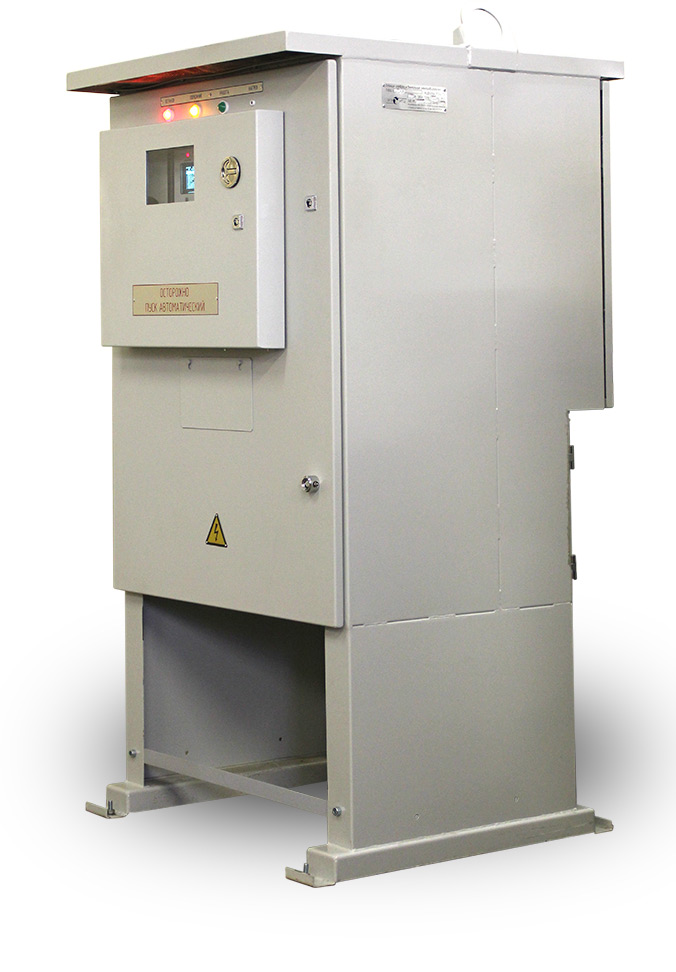
Purpose of the Control Stations
Control stations (CS) are designed for operation in integrated drives for electric submersible centrifugal pumps (ESP–PMM systems) and progressing cavity pumps (PCP–LSPMM systems) based on permanent magnet motors (PMM).
The control stations are intended for outdoor operation under climatic conditions corresponding to UHL1 category according to GOST 15150–69. The surrounding environment must be non-explosive and free from aggressive gases and vapors in concentrations capable of damaging metals and insulation, as well as free from conductive dust.
The harmonic distortion factor of induced voltage at the input terminals complies with the power quality requirements of GOST 32144.
Operating and Dimensional Characteristics
The input power supplied to the control station depends on the power rating of the connected motor.
The rated electrical parameters of the control stations are provided in the table below.
|
Control Station Type |
I nom., A |
I out., A |
Efficiency at Rated Current (minimum) |
VFD Output Power, kVA |
Power Consumption from Grid, kVA |
Maximum Connected Motor Power, kW |
|
|---|---|---|---|---|---|---|---|
|
PMM |
LSPMM |
||||||
|
SUVD–xx–080–xxxx |
80 |
100 |
0.95 |
60 |
65 |
– |
36 |
|
160 |
200 |
120 |
125 |
80 |
60 |
||
|
SUVD–xx–315–xxxx |
315 |
400 |
250 |
255 |
150 |
– |
|
Current overload of 1.25 times the rated value is allowed once per hour for a duration not exceeding 5 minutes.
The control stations are powered from a three-phase AC network with solidly grounded neutral and TN-C grounding system according to the 7th edition of the Electrical Installation Code (PUE).
Weight of control stations in standard configuration:
- “SUVD–080 and 160” – 280 kg.
- “SUVD–315” – 480 kg.
Maximum overall dimensions:
- “SUVD–080 and 160” – 1740 × 870 × 820 mm.
- “SUVD–315” – 1880 × 1060 × 890 mm.
Operating conditions:
- Rated supply voltage 380V+30/-25% at 50 Hz ±4%.
- Ambient temperature from –60°C to +50°C and relative humidity up to 100% at +25°C.
- Resistance to external mechanical impacts corresponding to M1 group according to GOST 17516.1 (IEC 721–3–(3,4,5,6,7)).
- Operational capability under frost and condensation conditions.
- Protection degree according to GOST 14254–96 (IEC 529): IP43, except the input/output section rated IP23.
Design and Operation
General Information
The control station operates as follows. After supply voltage is applied and the control station is switched on, the control software begins loading. During startup, self-testing and initialization of the control system are performed. The integrity of program memory, controllers, processors, communication channels, and parameter monitoring circuits is verified.
After entering the required settings and receiving a signal from the “START” button on the controller, the Variable Frequency Drive (VFD) generates output voltage of the required amplitude, waveform, and frequency from the incoming supply voltage. Overall VFD control is performed by the controller. Parameter setup and operational monitoring are also carried out through the controller.
The control station supports connection of surface telemetry units from all domestic and international manufacturers upon prior agreement with the Customer.
Key Technical Characteristics
Control stations provide:
- Control of PMM-type motors manufactured according to KPMS.652122.050 TU or PMM series according to KPMS.652154.000 TU.
- Control of LSPMM-type motors manufactured according to KPMS.652122.040 TU or LSPMM series according to KPMS.652164.000 TU.
- Protection of the motor and control station during аварийных situations.
- Display of information on key motor operating parameters and control station self-diagnostics.
- Execution of operator commands from the local control panel or dispatcher commands from the process control console.
- Registration and processing of telemetry system (TMS) data.
- Data accumulation with adjustable logging intervals for subsequent processing.
- Transmission of information via cable and/or radio modem to the dispatcher console, including MODBUS RTU protocol support.
Control functions:
- Smooth startup and full control of PMM operation.
- Change of rotation direction (clockwise/counterclockwise) without stopping the motor.
- Operation in automatic modes, including intelligent control modes.
- Adjustment of shaft (rotor) rotational speed for LSPMM-type motors within 200–1500 rpm with ±50 rpm accuracy and within 80–750 rpm without TMPN operation with ±10 rpm accuracy.
- Adjustment of shaft (rotor) rotational speed for PMM-type motors within 500–7000 rpm with ±50 rpm speed stability.
Protection functions:
- Protection against phase loss in the primary power supply network.
- Protection against phase-to-phase short circuits in motor windings or power cable conductors.
- Motor overcurrent protection according to preset values.
- Motor undercurrent protection according to preset values.
- Motor current protection based on predefined ampere-second characteristics.
- Protection against motor underload from 15 to 50% below stabilized operating current.
- Protection against motor overload from 0 to 50% above stabilized operating current.
- Protection against turbine reverse rotation of the pump.
- Protection against insulation resistance reduction in the “Submersible Motor – Cable – TMPN” system below the preset threshold of 30 kOhm.
- Protection against supply voltage deviations exceeding +30/–25% at nominal voltage U nom. = 380V.
- Protection against excessive or insufficient wellhead pressure through automatic pressure gauge contact switching.
- Protection against unauthorized modification of station settings.
- Protection against lightning and switching impulse overvoltages occurring in electrical networks.
- Configurable Automatic Restart (AR) mode for each protection function.
Monitoring functions:
- The station allows monitoring, modification, and saving of settings and operating parameters.
- The station provides parameter logging and monitoring.
Compatibility with Surface Telemetry Units
The control station design allows installation and connection of the following types of surface telemetry units:
- TMS–E5 — telemetry interface unit manufactured by IRZ TEK for receiving and transmitting information from the BP–103 downhole telemetry module.
- TMSN–3 — telemetry interface unit manufactured by ELEKTON for receiving and transmitting information from the TMSP–3 downhole telemetry module.
- SKAD–2002VM–SKS — telemetry interface units manufactured by Oil Measurement Systems LLC for receiving and transmitting information from the SKAD–2002VM–PSM downhole telemetry module.
- Surface telemetry units are installed in the lower part of the VFD compartment on a dedicated mounting bracket. All required mounting hardware is included in the spare parts kit supplied with the control station.
All required wires and cables are ordered and supplied together with the telemetry surface units.
Documentation
| Riteks-03 Control Station | |
|---|---|
| Operating Manual | Download |
| Technical Specifications | Download |
| Riteks-04 Control Station | |
| Operating Manual | Download |
| Technical Specifications | Download |
| For All Riteks Control Station Types | |
| Operating Manual | Download |
| Technical Specifications | Download |
| For All SUVD Control Station Types | |
| Operating Manual | Download |
| Technical Specifications | Download |